
We enable a robot to learn a flying knot in less than 10 trials given a single human demonstration.

Learning Deformable Object Manipulation Using Task-Level Iterative Learning Control

1Carnegie Mellon University

A flying overhand knot is performed by manipulating one end of a rope without changing grip. The motion lifts and twists the rope to form a loop, then arcs to strike near the rope end so it flips through the loop and tightens as the rope falls.

Task-Level Iterative Learning Control

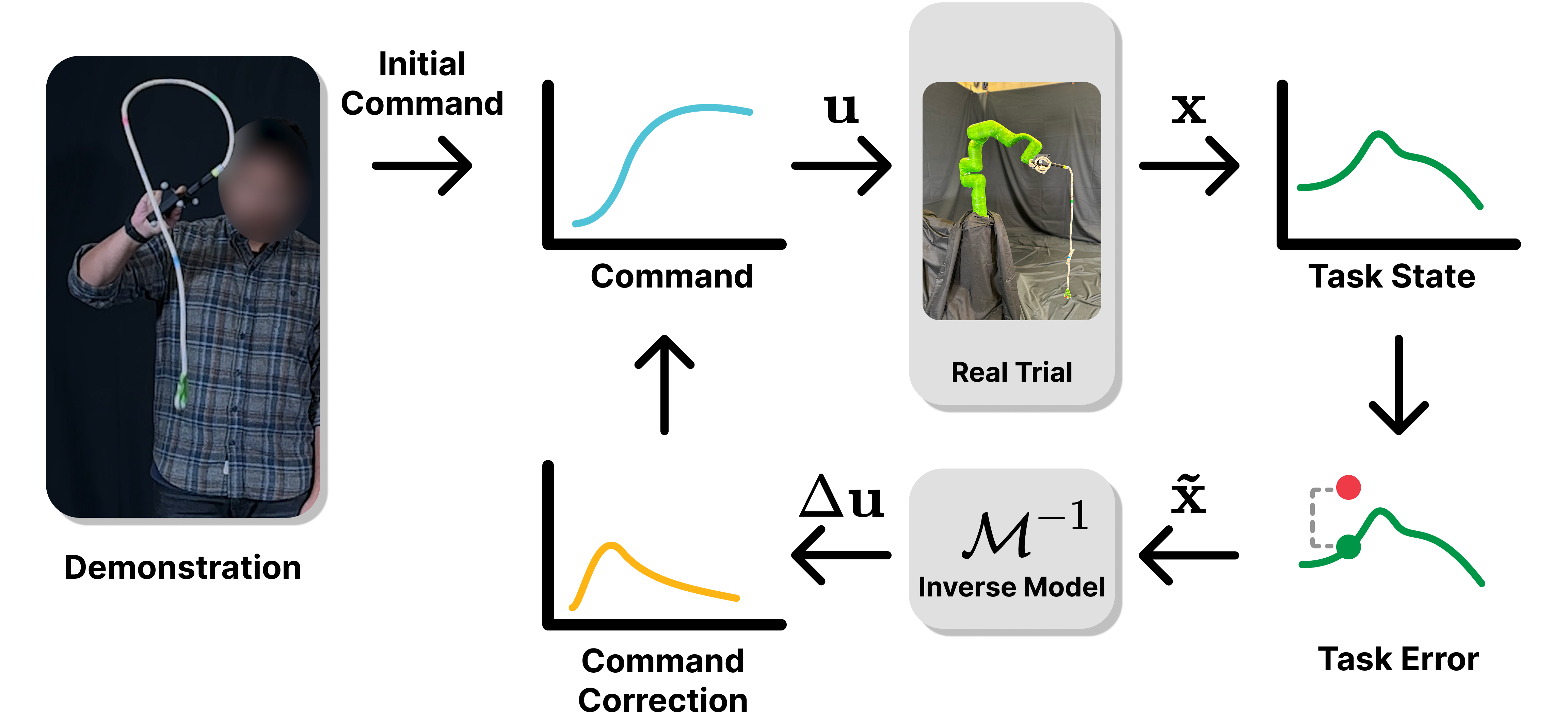
Task-Level ILC system diagram

Task-Level ILC improves a feedforward command over repeated hardware trials by mapping measured rope task errors into command updates with an inverse model. Learning is focused on a single critical-point of the task at rope collision.

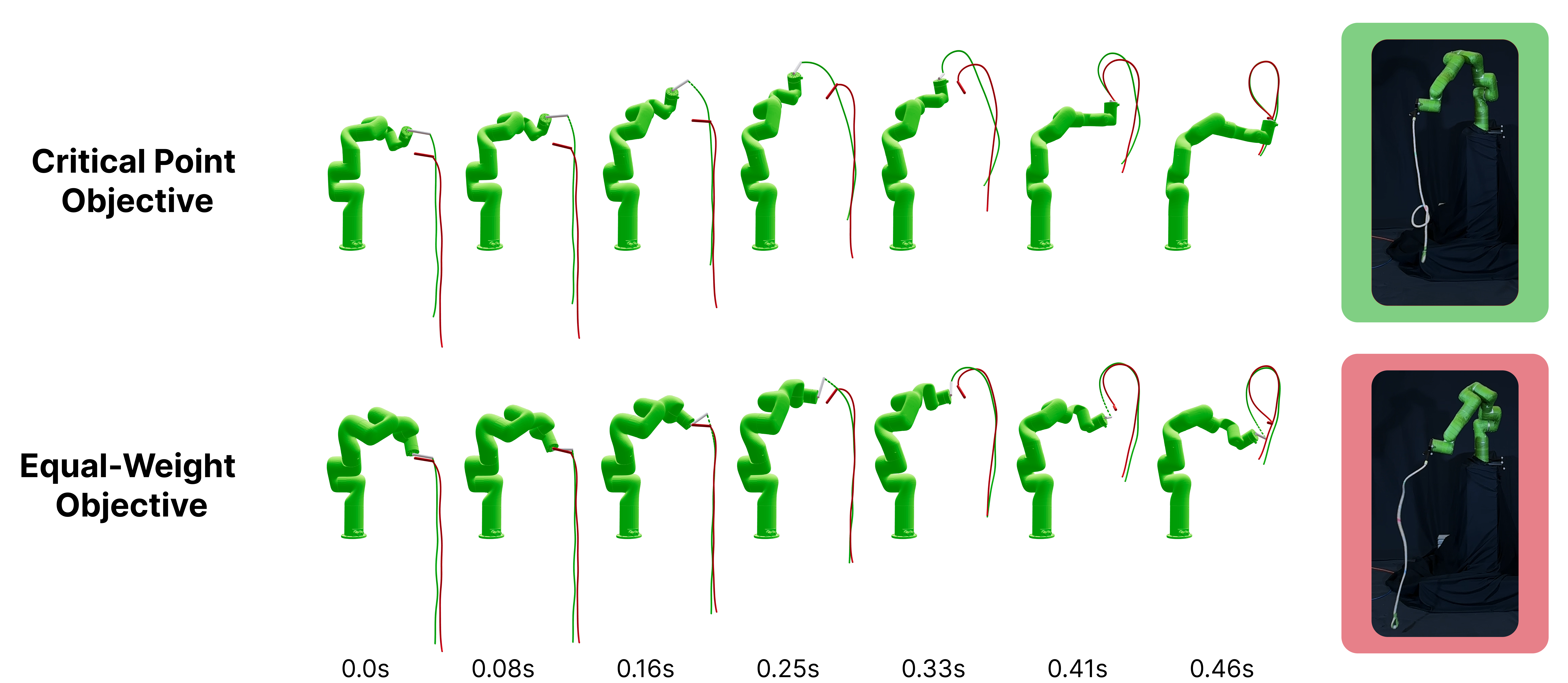
Critical Point Objective

The critical-point objective enables learning to succeed by ignoring errors at other times in the task and focuses learning on reducing error only at the critical point. The flying knot has many key moments, but we select rope collision as the critical point. The figure below shows the difference after learning with the critical-point objective vs the equal-weighted.

1/8x speed

Critical-point objective versus equal-weighted objective comparison

Learning Robustness

We evaluate the learning algorithm on different rope types:

We also evaluate learning across demonstration variations:

Once the learning succeeds the robot is 100% successful on 40 repeated trials.

Selection of fast flying knot performed 40 times - 10x speed

Abstract

Dynamic manipulation of deformable objects is challenging for humans and robots because they have infinite degrees of freedom and exhibit underactuated dynamics. We introduce a Task-Level Iterative Learning Control method for dynamic manipulation of deformable objects. We demonstrate this method on a non-planar rope manipulation task called the flying knot. Using a single human demonstration and a simplified rope model, the method learns directly on hardware without reliance on large amounts of demonstration data or massive amounts of simulation. At each iteration, the algorithm constructs a local inverse model of the robot and rope by solving a quadratic program to propagate task-space errors into action updates. We evaluate performance across 7 different kinds of ropes, including chain, latex surgical tubing, and braided and twisted ropes, ranging in thicknesses of 7-25mm and densities of 0.013-0.5 kg/m. Learning achieves a 100% success rate within 10 trials on all ropes. Furthermore, the method can successfully transfer between most rope types in approximately 2-5 trials.

BibTeX

@article{suresh2026learningdeformableobjectmanipulation,
      title={Learning Deformable Object Manipulation Using Task-Level Iterative Learning Control}, 
      author={Krishna Suresh and Chris Atkeson},
      year={2026},
      eprint={2602.21302},
      archivePrefix={arXiv},
      primaryClass={cs.RO},
      url={https://arxiv.org/abs/2602.21302}, 
}